Bologna in 2 days: what to see, what to eat and where to stay
Hello Stirati! Two days in my Bologna among porticoes, leaning towers and tortellini in broth: a day-by-day itinerary, what to eat and tricks for spending little.
Start here
Hello Stiratini! Today I'm playing at home and taking you around my Bologna, the one everyone calls the Learned, the Fat and the Red: Learned for the university, Fat for what ends up on the plate, Red for the colour of the bricks and roofs.
This is the itinerary I would follow with a friend just off the train: squares, leaning towers, porticoes, a climb you will feel, and plenty of fresh pasta. Comfortable shoes and off you go.
In brief
- How many days: 2 full days for the centre and San Luca. If you have a spare day, the sea is not far: read my article on Cervia and Milano Marittima.
- Best time to visit: spring and autumn. Summer is muggy, winter is often foggy, but a tortellino in broth makes up for everything.
- Who it is for: for people who love eating, walking and exploring, as a couple, with friends or on their own.
- Budget: medium-low. Most of the money goes on food, and it is worth it 💸
What to see
Piazza Maggiore and San Petronio
📍 Piazza Maggiore is the living room of the city, between Palazzo d'Accursio, the Palazzo del Podestà and the Basilica of San Petronio, one of the largest churches in Italy. The facade was left unfinished, marble at the bottom and bare brick at the top, and Bolognese people like it that way. Inside, look for Cassini's meridian line, traced on the floor in the seventeenth century: at solar noon a ray of sunlight falls on it through a small hole in the vault.
📍 Next to it is the Fountain of Neptune, known to everyone as «il Gigante», a sixteenth-century bronze by Giambologna. Walk round behind the statue and find the right angle: you will understand why it makes half the city laugh.
The Two Towers
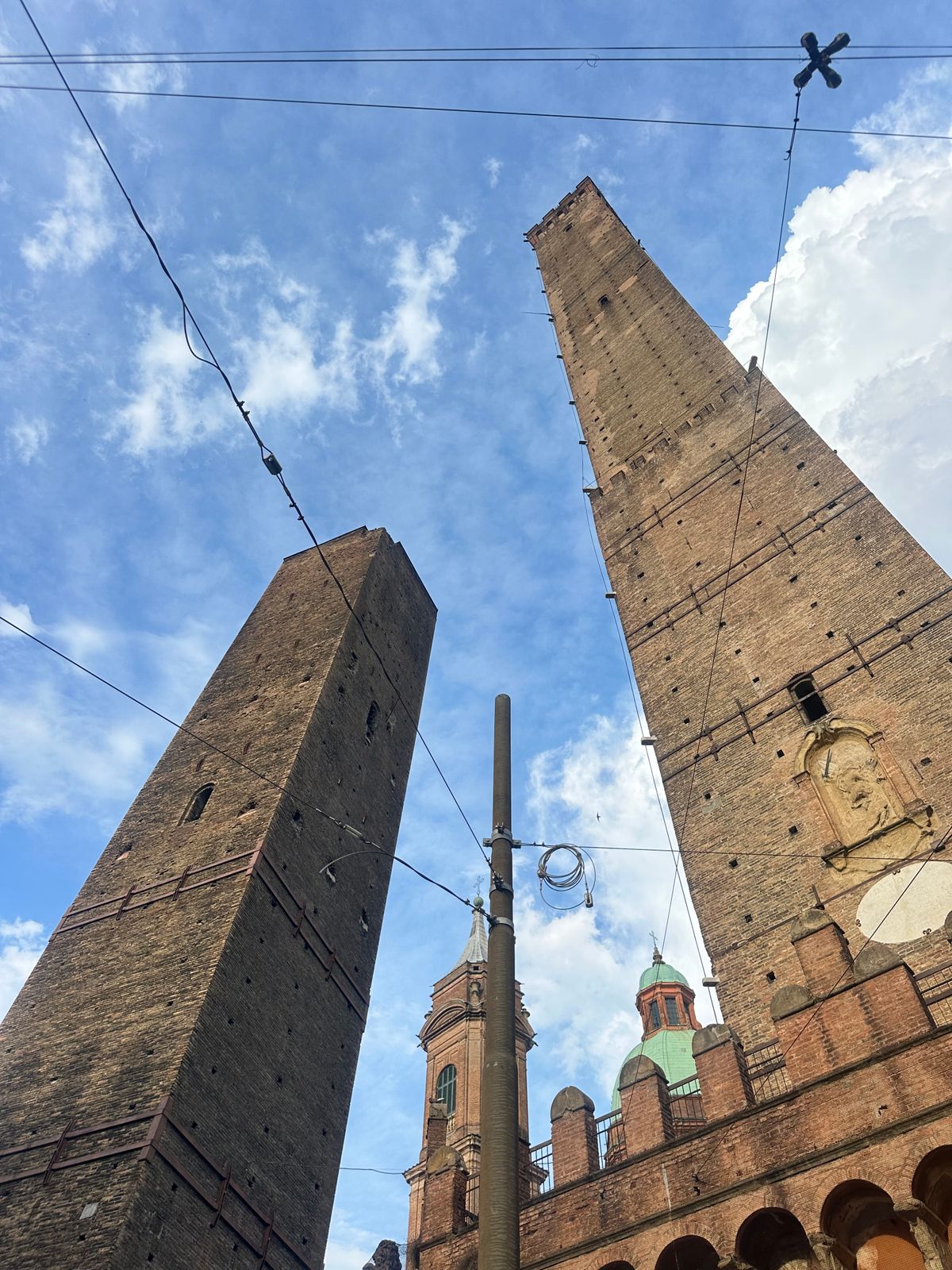
📍 The Asinelli and Garisenda towers are the symbol of Bologna: the first very tall, the second shorter and so leaning that even Dante mentions it in the Inferno. In the Middle Ages the city was full of towers, and these are the most famous that remain. Since October 2023 the Garisenda has been surrounded by a safety works site and the climb up the Asinelli is suspended: before setting off, check whether it has reopened.
Archiginnasio and the Anatomical Theatre
📍 For more than two centuries the Archiginnasio was the seat of the University of Bologna, which is traced back to 1088 and is considered the oldest in the Western world. The walls are covered with coats of arms. Upstairs is the Anatomical Theatre, all in wood: the canopy over the professor's chair is held up by two statues of men without skin, the «Spellati». Bombed in 1944, it was rebuilt after the war. For opening times and tickets, check before you set off.
Santo Stefano
📍 Piazza Santo Stefano is one of the most beautiful squares in the city. It is overlooked by the complex that Bolognese people call «le Sette Chiese»: churches fitted one inside another, with cloisters and courtyards where it is easy to get lost. Lower your voice when you go in: it is one of the oldest and quietest corners of Bologna.
Quadrilatero and Via Piella
📍 Behind Piazza Maggiore lies the Quadrilatero, the old medieval market: lanes such as via Pescherie Vecchie and via Drapperie, shops selling cured meats and cheeses, and osterie with tables outside. Here you look, sniff and taste. Then reach via Piella and open the little window: below flows the Canale delle Moline, between the houses. Bologna was a city of canals, and this view recalls that.
Porticoes and San Luca
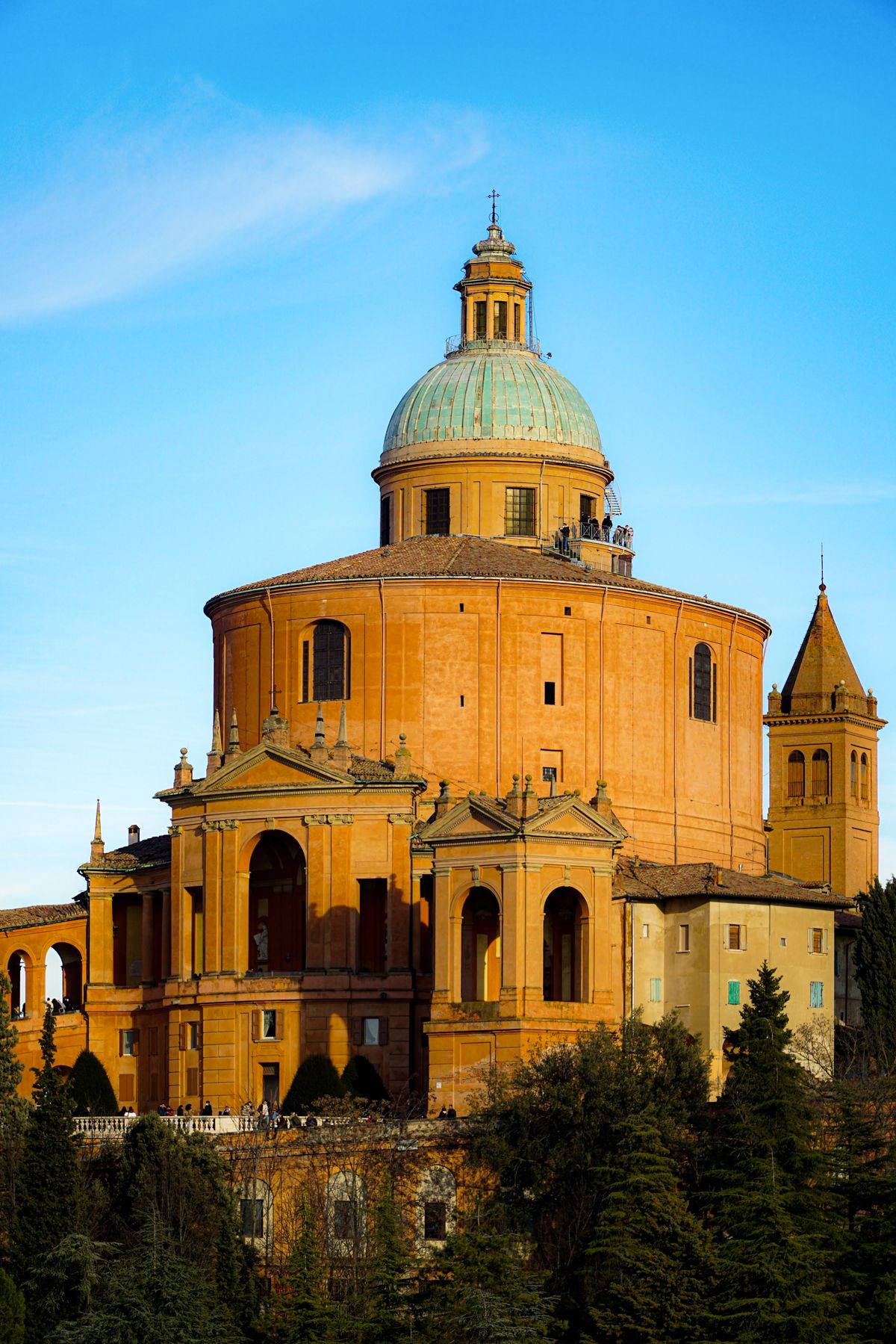
📍 The porticoes are Bologna's signature: kilometres of arches that shelter you from rain and sun, a UNESCO World Heritage Site since 2021. The most spectacular climbs from Porta Saragozza to the Sanctuary of the Madonna di San Luca on the Colle della Guardia: it is the longest portico in the world, almost 4 kilometres. The real climb begins at the Arco del Meloncello, and the view from up there rewards every step.
Day-by-day itinerary
Day 1: the centre on foot
Start from Piazza Maggiore: go into San Petronio, say hello to the Neptune statue and slip into the Archiginnasio, right next door. At lunch, get lost in the Quadrilatero with a board of mortadella and crescentine. In the afternoon head to the Due Torri, then take via Santo Stefano to the square and wait for the light to turn orange on the brickwork. Dinner with tagliatelle al ragù and a digestive stroll under the porticoes.
Day 2: San Luca and the hidden Bologna
Morning at San Luca: set off early from Porta Saragozza and climb at your own pace, since after every climb there is always a descent. Return to the centre for tortellini in broth, then an afternoon of exploring: the little window on via Piella, the university area of via Zamboni, the less-trodden porticoes. If it rains, it is time for virtual reality (I tell you more in the Stiratа tips). Finish with a stroll around Piazza Maggiore, which is a different place in the evening.
Getting around
- On foot: you can get around the whole centre on foot, almost always under cover, and it costs nothing.
- City buses: useful for the Arco del Meloncello and outside the centre. For routes and tickets, check before you set off.
- From the airport: the Marconi Express, the elevated monorail, takes you to Bologna Centrale station in a few minutes.
- By train: Bologna Centrale is a high-speed rail hub. Watch out: the high-speed platforms are several levels underground, so leave yourself a few minutes' margin.
- By car: the centre is a limited traffic zone, so it is best to leave the car outside.
What to eat
People come to Bologna also, and perhaps above all, to eat. The bare minimum:
- Tortellini in broth: small, filled with meat, in steaming broth. The festive dish.
- Tagliatelle al ragù: here the ragù goes on the tagliatelle. Nobody orders «spaghetti alla bolognese» in Bologna 😉
- Green lasagne: spinach pasta sheets, ragù and béchamel. Heavy? Yes. Regrets? Never.
- Mortadella: in thin slices, in cubes with an aperitivo, or inside a warm crescentina. The genuine article is Mortadella Bologna IGP.
- Crescentine and tigelle: crescentine are puffed, fried dough to fill with cured meats, while tigelle are small discs cooked in a tigelliera, typical of the Modena Apennines. The only catch is that in Modena they call the tigella a crescentina, and people have always argued about that.
- Friggione: onions and tomatoes cooked slowly for hours. The side dish that begs for bread to mop it up.

Where to stay
- Historic centre: between Piazza Maggiore and the Due Torri you have everything within walking distance. Very convenient and usually the most expensive.
- Santo Stefano and Strada Maggiore: elegant areas, a short walk from the Due Torri.
- University area: around via Zamboni, lively and young. It can be noisy at night.
- Station area: practical if you arrive by train or on the Marconi Express, and often cheaper.
Stiratа tips
I don't iron, but I'm ironed 💸 Here's how to enjoy Bologna without overspending.
- 👉🏻 The best things are free: squares, porticoes, the little window and the walk up to San Luca cost nothing.
- 👉🏻 Lunch from the market: a board of mortadella and crescentine shared between two is a proper lunch, and your wallet will thank you.
- 👉🏻 Umbrella? You hardly need one: with all these porticoes, make room in your suitcase for the mortadella.
- 👉🏻 Train booked in advance: compare trains and buses on Omio. With my Omio link and the code pp4ay1ya you get 12% off.
- 👉🏻 A trip without a suitcase: if it rains or you want a different evening, there is Zero Latency VR Bologna, free-roam virtual reality where you really move around and play in a team. With the code STIRATI you get 15% off.
Honest disclosure: these are affiliate links, so you get a discount and I get a small commission. All links and codes are under Travel discounts.
Stiriosity
😱 Did you know? 😱
- The whispering wall: under the Voltone of the Palazzo del Podestà, next to Piazza Maggiore, stand in a corner and whisper to the wall. Someone standing in the opposite corner, diagonally, will hear you perfectly.
- 666 arches: that is how many arches the portico of San Luca has. It is said the portico represents the serpent, that is the devil, crushed by the Madonna at the top of the hill.
- The tagliatella has an official size, registered with the Bologna Chamber of Commerce: once cooked it is about 8 millimetres wide, the 12,270th part of the height of the Asinelli Tower.
My videos
I often feature Bologna in my reels:
- San Petronio, the basilica on Piazza Maggiore
- The pizzerias of Bologna, because you cannot live on ragù alone
- Ducati's 100 years, born right here
- Afghan cuisine in Bologna, a trip around the world without taking a plane
For all the other stories, follow me on Instagram and TikTok: I am @stiratiintrip.
Bologna is waiting for you, and so are the tortellini. And you, have you ever been? What first course would you order? 🫵🏻
Travel creator from Bologna. I don't iron, but I am ironed: I tell stories of fantastic trips, write free itineraries and always look for the low-cost solution 💸
Keep travelling
Assisi in a weekend: an itinerary through art, history and Umbrian flavours
Cervia and Milano Marittima: a seaside weekend in Romagna
Rio de Janeiro in a week: what to see and do
Assisi in a weekend: an itinerary through art, history and Umbrian flavours
Cervia and Milano Marittima: a seaside weekend in Romagna
Rio de Janeiro in a week: what to see and do
Comments from the Stirati
No comments yet. Start the conversation.